One Long Line or Several Short Ones?
One long line or several short ones? See how garment lengths and layers change outfit proportion, then adjust hems and openings to suit your intended shape.
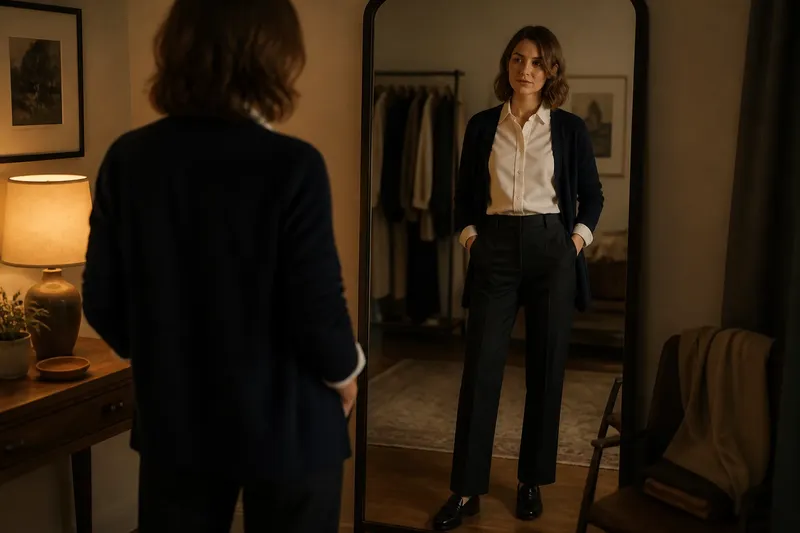
One long line or several short ones? Imagine standing in front of a mirror in straight-leg trousers, a shirt, and an open cardigan, unsure why the outfit feels chopped into pieces. The issue may not be any single garment; it may be where the hems and edges divide the view. A small change in length can shift the whole impression of proportion.
Consider a clearly invented situation: Maya is choosing an outfit for a casual office day. She wants to wear a cream button-down, dark straight-leg trousers, and a navy cardigan. The pieces are comfortable, but the shirt hangs below the cardigan and both hems land at awkwardly close points around her hips. She tries a few deliberate adjustments and watches what each one changes.
What does an uninterrupted line do?
An uninterrupted line gives the eye a relatively long path through the outfit. It does not mean wearing one color from head to toe or hiding every seam. Rather, the garment edges and visible layers avoid creating many strong horizontal stops across the body.
Maya first buttons her shirt and tucks it into her trousers, then wears the cardigan open. The waistband is no longer interrupted by a shirt hem, and the open cardigan creates two vertical edges. Her outfit still has distinct pieces, but the visible path now runs from shoulder toward trouser leg with fewer competing breaks.
Length matters because each hem creates an edge. A shirt ending near the waistband can read differently from one covering the seat; a cardigan ending at the upper hip creates another horizontal marker. Those edges are not inherently good or bad. Their effect depends on their position, the nearby garment shapes, and the line the wearer wants to emphasize.
To see the effect clearly, change one thing at a time. Keep the trousers and shirt fixed while trying the cardigan open, closed, and removed. A full-length mirror helps show the outfit as a whole; a phone photo taken from a consistent distance can also reveal whether the eye reads one continuous column or several blocks.
Where do layers create breaks?
A layer can divide an outfit through its hem, opening, fastening, or contrast with what sits beneath it. A closed jacket makes a broad front panel; an open one exposes the layer underneath and sets vertical edges. A short sweater over a longer shirt shows two separate hems, while a tucked shirt removes one of those visible stops.
Maya next closes her cardigan. Its front now forms a continuous panel, but its hem falls near the shirt hem. Together, the two edges make a conspicuous horizontal zone. She opens the cardigan again, which reduces the visual weight of that zone without changing either garment.
She also tries leaving the shirt untucked. The shirt tail extends below the cardigan, so the outfit has a longer back layer and a shorter front layer. The result looks more layered, but the lower shirt edge becomes an additional boundary. If she wanted a cleaner, longer impression, tucking the shirt would be the more direct choice; if she wanted visible layering, the exposed tail could be intentional.
Think about the kind of edge, not only its location. A soft, curved shirt tail may feel less like a hard dividing line than a stiff, straight jacket hem. A cardigan with a narrow placket can leave more of the base garment visible than a bulky zip-front layer. Fabric drape and construction affect how strongly a boundary registers.
How can garment lengths work together?
When several garments end close together, their hems can gather attention in one area. When they end at noticeably different points, they create a sequence of breaks instead. Neither arrangement automatically improves proportion: the useful question is whether the resulting shape supports the intended outfit.
Maya compares three versions in the mirror. In the first, the shirt is tucked and the cardigan is open, with the cardigan ending above the widest part of the trousers. In the second, the shirt is untucked and its tail extends well below the cardigan. In the third, she removes the cardigan and wears the shirt untucked. The first reads as a longer central line; the second makes the layering obvious; the third gives the shirt hem a clear role on its own.
She notices that the trousers’ rise also affects where the shirt can be tucked comfortably. If the waistband is higher on her torso, tucking may create a more continuous transition into the legs. If the waistband sits lower, a cropped jacket or a deliberately visible shirt hem might make more sense than forcing the same arrangement. The aim is not to follow a universal hem formula but to judge the actual garment on the body wearing it.
Proportion also changes when a layer is worn open or closed. Open edges can frame the torso and draw the eye vertically, while a closed front may create a single broad shape. A belt, pocket line, or button row can add another directional cue. Before adding accessories, Maya checks what the existing seams and closures already contribute.
How should you compare the versions?
Rather than asking which outfit is more flattering, Maya gives each version a specific job. She wants the office outfit to feel composed and easy to move in, with the shirt and trousers forming the main line. She does not need every hem hidden; she needs the visible breaks to look chosen rather than accidental.
Her comparison is straightforward: she stands in the same place, keeps her shoes on, and changes only the shirt treatment or cardigan position. She checks the front and side views, then walks and sits briefly to make sure the styling still works in motion. A hem that seems tidy while standing may shift when the wearer moves.
After comparing the options, Maya chooses the tucked shirt with the cardigan open. The waist remains visible, the cardigan’s front edges add length, and the shirt no longer competes with the cardigan hem. This is not a rule that all shirts should be tucked; it is a decision that fits these particular garments and her stated aim.
She keeps one alternate version in mind for a less formal day: the shirt untucked with the cardigan removed. That arrangement makes the shirt’s length the main feature and avoids stacking two nearby hems. Having a second workable shape is more useful than insisting on one styling trick for every layer.
Which questions help you read outfit proportion?
Does an open layer always look longer?
No. An open front can create vertical edges, but a very short or bulky layer may still emphasize its own hem. Check the full silhouette and the way the fabric falls rather than assuming an open garment automatically lengthens the appearance.
Should the shirt hem always sit above the jacket hem?
No fixed order suits every combination. A shirt tail extending below a jacket can look deliberate when the difference is visible and the fabrics sit well together; close, nearly aligned hems may look accidental if they bunch or compete.
How can I tell whether an outfit has too many breaks?
Look for several strong horizontal edges drawing attention to nearby areas, especially when multiple layers end close together. Remove or reposition one layer and compare; if the outline becomes easier to read, that change may better match the impression you want.
Can a long line include different colors or fabrics?
Yes. A long visual path can come from the placement of openings, seams, and hems, not just from matching color. Different materials may still form a coherent shape when their edges do not interrupt the line more than you intend.
What should you change first?
Start with the simplest reversible adjustment: open a layer, tuck or untuck a shirt, or remove one piece. Then look at where the remaining hems land and whether they make one clear line, several intentional sections, or a cluster of competing edges. Change one element at a time so you can tell what altered the outline.
It is not worth trying to calculate ideal hem positions or pinning every edge to a theoretical proportion. A mirror, familiar shoes, and a little movement tell you more about the outfit you actually wear. If a garment pulls, rides up, or restricts movement, comfort and fit matter more than preserving a visual line.
For Maya, the lesson is practical: proportion is not a property of a single cardigan or shirt. It emerges from how the pieces overlap and where their edges meet. The next time one long line or several short ones feels like the decision, identify the hem doing the most visual work and adjust that piece first.