Reading the Dress Code on a Daytime Invitation
Reading a daytime invitation dress code gets easier when you weigh its wording, venue and schedule, then choose an outfit that fits without overthinking.
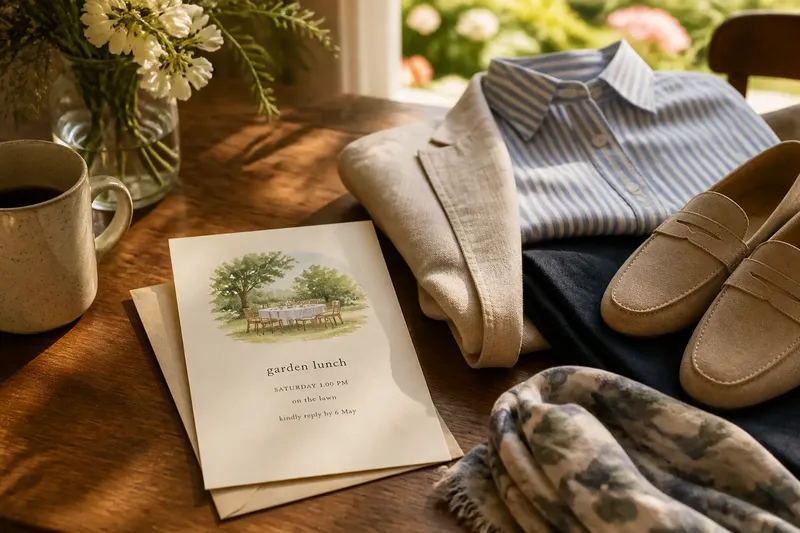
You open a Saturday invitation at the kitchen counter and see “garden lunch” beneath the address. There is no dress code, just a start time, a note about the lawn and a reply deadline. Reading a daytime invitation dress code is less about decoding secret rules than noticing which details affect comfort and formality.
Think of the invitation as a set of practical clues, not a puzzle with one correct outfit. Read the wording, consider the setting and schedule, then use your own clothes to land at an appropriate level without dressing for imagined expectations.
Which clues on the invitation carry the most weight?
Start with any explicit dress-code phrase. “Business casual,” “cocktail attire” or “formal” gives more direction than the event’s decorative language. If the invitation names a dress code, let that lead; use the venue and timing to refine your choices, not to overrule the request.
Next, look for practical notes: outdoors, grass, standing reception, religious service, patio, or “festive dress.” These details point to clothing decisions. A lawn suggests shoes that will not sink into soft ground; a service may call for a layer that covers shoulders. Neither clue requires buying a new outfit.
When an invitation is vague, the host’s wording still helps. “Join us for a relaxed brunch” sounds different from “luncheon reception” or “award presentation.” Treat those phrases as indications of tone, not strict categories. A polished everyday outfit often suits an invitation that gives no formal dress code.
- Explicit code: Follow the named level of dress.
- Venue: Note whether it is a home, restaurant, garden, place of worship or work setting.
- Activity: Check whether guests will sit, stand, walk or move between spaces.
- Host’s wording: Use words such as “casual” or “celebratory” as supporting clues.
- Practical notes: Take weather, ground conditions and requested attire into account.
Do not treat every visual detail as a signal. A floral invitation, a country-house address or a lunchtime start does not automatically mean a themed look, a hat or a particular color. If the host wanted a specific item or tradition, a direct note would be clearer.
How should the venue and time shape your choice?
Daytime events can range from an informal meal at a friend’s home to a formal ceremony. The hour alone does not tell you how dressed up to be. A midday wedding may call for more polish than an evening meal at a casual café, so read the event type alongside the clock.
Consider what the venue asks of your clothes. A restaurant with a smart dining room may suit tailored trousers, a neat dress or a coordinated skirt and top. For a garden gathering, a comfortable hem and stable shoes may matter more than a delicate detail that catches on seating or grass.
For a work-related event, use the workplace’s usual level of dress as a starting point, then adjust for the occasion. A client lunch may call for a sharper jacket or pressed shirt than a team picnic. Avoid assuming that every event held at a hotel or private club requires formalwear.
Weather belongs in the decision, but it should not take over. A light cardigan, unstructured blazer or scarf can make a sleeveless or short-sleeved outfit more adaptable. If the forecast is unsettled, choose a layer that works with the outfit rather than carrying a special garment you are unlikely to use.
Say you are invited to an afternoon birthday lunch at a restaurant, and the note says “smart casual.” You could start with a pressed shirt and dark trousers, then choose loafers or clean low-profile shoes based on the walk from the parking area. The result should look intentional at the table and remain comfortable on the way there, without adding a suit merely because the venue feels special.
What does a vague dress code usually mean?
When the invitation says “casual,” think neat and suitable for the activity rather than worn-out or gym-specific clothing. For “smart casual,” combine an easy piece with a more finished one: for example, a simple knit with tailored trousers, or a relaxed dress with clean, structured shoes.
“Festive” usually asks for a sense of occasion, not a costume. You might choose a lively accessory, a textured jacket or a dress with a little more polish than your daily default. Keep the rest of the outfit familiar so the celebratory element does not feel like an assignment.
If the wording is unfamiliar, ask the host a narrow question rather than requesting a complete outfit prescription. “Is the lunch mostly outdoors?” or “Would you describe the gathering as casual or dressy?” gives the host an easy way to clarify the practical point. A quick message is more useful than reading too much into photographs of the venue.
For an event with cultural or religious customs, use the invitation’s guidance if it provides any. If it does not, a discreet question to the host is more respectful than guessing from a location or a guest list. Choose an outfit that lets you participate comfortably while avoiding assumptions about what others will wear.
How can you check the outfit before you leave?
Try the outfit together, including shoes and any layer you expect to wear. Sit down, stand up and walk across the room. These simple checks can reveal a hem that rides up, a jacket that pulls when you reach forward or shoes that feel wrong before you have to spend the afternoon in them.
Check the overall finish rather than adding decoration by default. Are the clothes clean and reasonably pressed? Do the shoes suit the ground and activity? Is there a layer for a cool room or shaded patio? These questions address what guests and hosts will actually notice without turning preparation into a styling project.
It is not worth trying to match the invitation’s colors, guessing the host’s outfit or buying an accessory to prove you understood the occasion. Those details rarely answer the real question: can you move comfortably, and does your clothing show appropriate care for the gathering?
When the choice is between two outfits, favor the one that fits the venue and lets you take part without fuss. If one option is slightly more polished but still comfortable, it can be a sensible choice for an occasion whose wording leaves room for interpretation. There is no need to make a large leap in formality to cover every possibility.
Which details should you clarify with the host?
Should you ask what “smart casual” means?
Ask if the phrase is unfamiliar and the occasion matters to you. A short question about whether the event is closer to a casual lunch or a dressy reception can settle the level without asking the host to approve your outfit.
What should you ask about an outdoor event?
Ask whether guests will spend most of the time on grass, a patio or indoors if that affects shoes or layers. This is a practical question, not a request for a full forecast or detailed styling advice.
Should you confirm clothing customs for a ceremony?
If the invitation does not explain a relevant custom, ask the host or organizer what guests should keep in mind. A brief, respectful question is preferable to relying on assumptions about a community or venue.
What if the host does not reply?
Use the clearest information you have: the stated code, event type, venue and any practical notes. Choose a neat outfit that fits those clues and your comfort needs; do not postpone the decision while trying to infer a hidden rule.
How do you settle on a respectful, comfortable outfit?
Make the decision in a simple order. First, follow any explicit dress code. Then account for the setting and activity, including weather and walking conditions. Finally, select pieces you already know how to wear and check that they look cared for and work together.
That order keeps the invitation in proportion. A dress code is useful information, but it does not require you to copy an imagined uniform or abandon your own style. For reading a daytime invitation dress code, the best choice is usually the outfit that respects the host’s request, suits the real setting and lets you focus on being there.
Before you leave, glance at the invitation once more for a detail you might have missed, such as “outdoors” or “please remove shoes indoors.” That small check is more useful than a last-minute outfit change prompted by nerves.